Screen 01 of 9 · Risk
Risk Register
Keep every risk in one register: score it on likelihood and impact, assign owners, see what needs attention, decide sign-offs and export it.
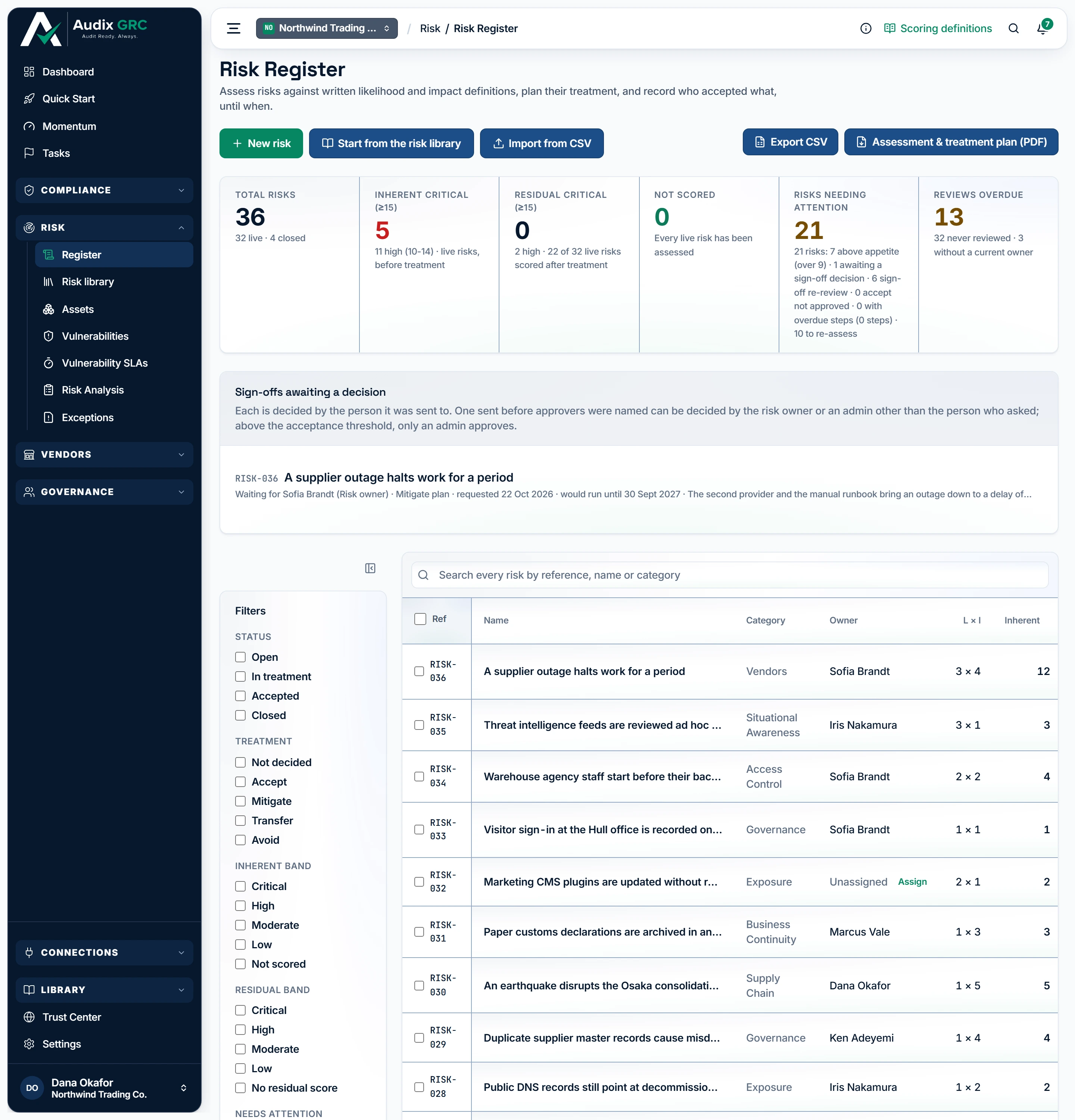
- Three ways to fill the register. Write a risk from scratch with New risk, start from the risk library and add risks with the controls each one suggests, or import the spreadsheet your organisation already keeps. All three are for admins; everyone else gets Browse the risk library.
- Sign-offs still to be decided. Each one names the person it was sent to, the treatment it covers and how long it would run. The card is there only while at least one is waiting.
- One scored row per risk, with its owner. Likelihood multiplied by impact gives the inherent score, and the score decides the band: Critical at 15 or more, High from 10 to 14, Moderate from 5 to 9, Low below that. An admin ticks rows to act on several at once.
Tiles for Total risks, Inherent critical (≥15), Residual critical (≥15), Not scored, Risks needing attention and Reviews overdue, the Sign-offs awaiting a decision card when any are waiting, Export CSV and Assessment & treatment plan (PDF), and a filterable, searchable table of every risk with its Owner. The header links to Scoring definitions.
Audix GRC Risk register: assess, treat and sign off risks
In Risk
Tasks on this screen
Keep a register of what could go wrongLive
A numbered list of named risks, each assessed against your written level definitions, owned and given a treatment decision, so you can show an auditor you know your own risks.
As a member
- Open Register under Risk. The page is titled Risk Register.
- Read the tiles: Total risks with how many are live and closed, Inherent critical (≥15) and Residual critical (≥15) with the high counts beneath them, Not scored, Risks needing attention and Reviews overdue. Every tile counts the whole register, and the bands count live risks only.
- Filter by Status, Treatment, Inherent band, Residual band, Needs attention, Owner, Category and Review due. Needs attention offers Not scored, Sign-off needs re-review, Sign-off awaiting decision, Accept decided, not approved, Treatment actions overdue, Duplicate reference, Above appetite, no sign-off, No owner, Owner left the organisation and Re-assess.
- Search every risk by reference, name or category. Click the Inherent or Residual column header to sort by score: highest first, then lowest first, then newest.
- The table shows 25 risks a page. Choose 10, 50 or 100 with Show.
- Click a row to open the risk.
As an admin
- Click New risk. Step 1, Identify, takes a Reference ID such as
RISK-001, a Category, a Name and a Description. - Click Continue. Step 2, Score, takes Likelihood and Impact. Each option shows the level and its label, for example
3 · Possible, and the written definition sits under the picker. Leave both on Not scored until the risk has been assessed. Residual likelihood (optional) and Residual impact (optional) follow. - Click Continue. Step 3, Treat, takes the Treatment option, Treatment plan (optional), Owner and Next review date (optional). A new risk always starts Open.
- Click Add risk. The inherent score is likelihood times impact.
- To change a risk later, open it and click Edit risk: name, category, description, both pairs of scores, treatment option, plan and next review date. Click Save changes. The risk's owner can do the same on a risk they own.
Rules that apply
- Inherent score is likelihood times impact. The bands are fixed: Critical at 15 or more, High 10 to 14, Moderate 5 to 9, Low below 5. Inherent and residual each have their own band. A risk that is not scored sits in no band and reads Not scored wherever a score would be.
- Set both likelihood and impact, or leave both blank. One on its own is refused with "Set both likelihood and impact, or leave both blank until the risk is assessed". The residual pair follows the same rule.
- A residual score higher than the inherent score is refused: "Residual is what is left after treatment, so lower the residual likelihood or impact, or re-score the inherent risk."
- Each reference is used once in your organisation, ignoring capitals. One already in use is refused with "The reference … is already used by … Each risk needs its own reference: choose another one." References shared before this rule are flagged Duplicate reference, and a banner above the table says how many there are.
- A risk with no owner reads Unassigned in the Owner column, and one whose owner left reads A former member. Both count under Needs attention. Editing a risk never clears its owner.
- A risk becomes Accepted only when an Accept sign-off is approved by the person it was sent to.
- A next review date in the past reads overdue, on the table and on the risk page.
Start the register from the risk libraryLive
Fill the register with specific risks written for you, each arriving with the SCF controls that mitigate it, instead of typing every one.
As a member
- Open Risk library under Risk, or click Browse the risk library on the register.
- Pick a category in the rail. Each one shows how many risks it holds and, under the search, what it covers. Everything shows them all, and the SCF risk catalogue and the SOC 2 starter risks sit below the 13 categories.
- Search by name, code or summary, and tick Not in my register to hide what you already have.
- Each row reads its title, its category and its controls, for example "5 controls, 3 already in your controls". A risk you already added reads In your register.
- Click a risk to read What the risk is, the Suggested controls, each with a pill saying how ready it is in your organisation, and the Related entries that overlap it.
As an admin
- On Risk Register, click Start from the risk library, or open Risk library from the sidebar.
- Tick the risks that apply, one by one, or tick Select all N shown that are not in your register for the category, search or filter on screen.
- Keep Link suggested controls ticked to link each risk's suggested controls as it is added. Tick Skip controls we have not adopted to link only controls already in your scope.
- To leave one suggested control out of a risk, open the risk and untick that control.
- Click Add N to register. The toast reads, for example, "Added 12 risks to the register, unscored, ready to assess."
Rules that apply
- The library holds 219 risks in 13 categories: Access, People, Vendors, Data protection, Privacy, Systems, Assets, Availability, Physical, Detection and response, Governance, Legal and regulatory, and Artificial intelligence. Each suggests 2 to 6 SCF controls.
- An added risk arrives unscored and untreated, ready to assess. Its page carries a From the risk library chip with its code, such as
RL-ACC-001, and its History starts with "Added from the risk library", naming the library entry and version and the controls it linked. - A risk already in your register cannot be added twice, not even by a double click. At most 300 risks are added at a time.
- A suggested control you left out, or unlinked later, stays on the risk's page as a suggestion with a one-click Link. Nothing links it again on its own, and a later version of the library never changes a risk already in your register.
- SCF risks come without suggested controls, because SCF relates each one to far more controls than anyone could link. Link controls on the risk's page once it is in your register. The two SOC 2 starter risks, on fraud and on significant change, link their controls like library risks.
- A control retired from the catalogue is never linked.
- The register CSV has a Catalogue entry column naming where each added risk came from.
- Only an admin adds risks: "Only an admin can add risks from the library to the register. You can browse every entry and its controls."
Import the risks you already keep in a spreadsheetLive
Fill the register from the spreadsheet you already keep, with every row checked before anything is created.
As a member
- Not available. Import from CSV is offered to admins only.
As an admin
- On Risk Register, click Import from CSV and choose a CSV with one risk per row, up to 3.0 MB, about 10,000 rows. Only Name is required, and headings such as Risk Title, Probability, Consequence and Risk Owner are recognised.
- Read the preview: how many risks are ready to import, how many will be skipped and why, which columns were ignored, and which rows may already be in your register. Nothing is created until you click Import N.
Rules that apply
- An imported row stays Not scored unless it gives both likelihood and impact. A row with only one of the two is refused.
- A row is refused, with its reason, for a date that does not exist such as 2026-02-30, text after a date, or a field longer than it takes, for example a name over 300 characters. Dates are read as YYYY-MM-DD or DD/MM/YYYY.
- A reference already in your register is refused for that row: "A risk with reference … already exists. Remove the row or change its reference." So is one repeated in the file. A row with no reference gets the next number in your sequence.
- A row whose name matches a risk already in the register imports with a warning that it adds a second one.
- A row marked accepted imports as Open with treatment Accept and a warning, so the sign-off is requested and approved in Audix rather than asserted by a file.
- A CSV exported from a register, in this organisation or another, can be imported as it is. Its Catalogue entry column is ignored.
- An import takes a lock on your register, so a double click cannot add the rows twice.
Write down what each score meansLive
Give each likelihood and impact level a label and a written definition, so every score in the register is read the way it was meant.
As a member
- Click Scoring definitions in the Risk Register header. The page is titled Risk scoring definitions.
- Read Likelihood ("How likely the risk is to happen, over a stated period.") and Impact ("How bad it would be for customers, operations and obligations if it did."), each with levels 1 to 5, a label and a definition.
- A pill says whether these are Your definitions or the Default definitions. There is nothing to edit for you.
As an admin
- Click Edit definitions, change any label or definition, and click Save definitions. The page confirms "Saved."
- Fill in the defaults puts the shipped wording back into the form, for you to edit before saving. Cancel throws your changes away.
Rules that apply
- Until you save your own, the defaults apply. Likelihood runs Rare, Unlikely, Possible, Likely and Almost certain. Impact runs Negligible, Minor, Moderate, Major and Severe.
- The definitions show beside every score: in the score pickers, on the risk page, and as the method in the Risk Assessment and Treatment Plan PDF.
- A label is up to 60 characters and a definition up to 1,000.
- Every change is kept in the audit log with the wording before and after it.
Set the risk acceptance policyLive
Decide how much risk the owner of a risk may sign off alone, how long a sign-off may run, and how often each band of risk is reviewed.
As a member
- Open Scoring definitions from the Risk Register header and read Risk acceptance policy: the Acceptance threshold, the Longest sign-off and the Review cadence for each band.
- A pill says whether this is Your policy or the Default policy. There is nothing to edit for you.
As an admin
- Click Edit policy.
- Set Acceptance threshold (score), from 1 to 25: "Above it, only an admin may approve a sign-off."
- Set Longest sign-off (months), from 1 to 36. Sign-offs already approved keep their end dates.
- Under Review every (days), set Critical, High, Moderate and Low, each from 7 to 365 days.
- Click Save policy. Fill in the defaults puts the shipped values back into the form, and Cancel throws your changes away.
Rules that apply
- Until an admin saves a policy, the defaults apply: a threshold of 9, sign-offs of at most 12 months, and reviews every 90 days for critical risks, 180 days for high and 365 days for moderate and low.
- At or below the threshold, the risk's owner or an admin can approve a sign-off. Above it, only an admin can.
- A risk scored above the threshold with no sign-off is flagged Above appetite, no sign-off, on the risk and in the register's filters.
- The cadence decides a risk's next review each time it is reviewed, from its residual score, or its inherent score when it has no residual one. A score raised into a band reviewed more often pulls the next review in.
Ask for a risk sign-off, and decide oneLive
Record that the risk left after treatment was accepted, why and until when, decided by the one person the requester chose.
As a member
- Open a risk and read the Risk sign-off card. Every treatment ends in a sign-off: for Accept, the risk is accepted; for Mitigate, Transfer or Avoid, the plan is approved and the risk that remains is accepted.
- On a scored risk you own, click Request acceptance, Request sign-off of the plan, or Request a renewal on one already accepted.
- Fill Why is this risk acceptable?, or Why is the risk left after this plan acceptable?, and Signed off until, which defaults to a year out within your organisation's longest sign-off.
- Under Send to, choose who decides it: the risk's owner or an admin, each labelled. "Only the person you choose can approve or reject it. They are told in the app and it appears in their Tasks. You or an admin can send it to someone else, or withdraw it, until it is decided."
- Click Send for approval. The card reads "Waiting for <name> (Risk owner) since <date>", or "(Admin)".
- On a request sent to you, add an optional note and click Accept this risk, or Approve the plan and accept the remaining risk, or Reject.
- On your own request, click Send to someone else to change who decides it, or Withdraw request. On a sign-off in force on a risk you own, End sign-off or End acceptance ends it now.
As an admin
- Request, send to someone else, withdraw and end sign-offs on any risk, with the same buttons.
- On Risk Register, Sign-offs awaiting a decision lists every open request and who must decide it. A Yours to decide pill marks the ones sent to you.
Rules that apply
- Only the person a request was sent to can approve or reject it. Anyone else, the risk's owner and admins included, is told: "This sign-off was sent to someone else to decide. The requester or an admin can send it to you."
- You never decide your own request. Send to offers the risk's owner and the admins, never you. Above your organisation's acceptance threshold, it offers admins only. An approver or an auditor is never offered.
- When nobody can be chosen, the reason replaces the Send for approval button, for example "Nobody else can approve this sign-off yet: you cannot approve your own, and there is no admin other than you. Give the risk an owner other than you, or invite a second admin."
- A sign-off needs a scored risk and an owner who is a current member: "Score the risk before asking for a sign-off: the approver has to know what level they are agreeing to live with." A closed risk cannot be signed off, and a risk has one request waiting at a time.
- The person chosen is told in the app, and the request is in their Tasks, due a week after it reached them. While it waits, it is listed in their weekly summary and emailed to them each Monday, unless they turned their summary off.
- Send to someone else asks for the new person and an optional note. The new person and the requester are told, and so is the person it was taken from: "Sign-off no longer yours to decide". The change is kept on the risk's History.
- A request made before approvers were named reads "Not sent to anyone in particular: the risk owner or any admin can decide." with Choose approver.
- Only an approved Accept sign-off makes the risk Accepted with treatment Accept. Approving a plan changes neither the status nor the treatment option. Ending an acceptance puts an accepted risk back to Open.
- An approval covers the scores it was given at. A request made at an old score cannot be approved, and a risk re-scored since its approval reads "Score changed since approval: re-review". A lapsed sign-off reads Acceptance expired. Both count under Needs attention and are chased on the deadlines feed.
- A risk whose treatment option is Accept, with nothing approved or requested, is flagged Accept chosen, not approved.
- Reject, End sign-off and Reopen each ask you to confirm, with an optional note. Every decision is kept, with who made it, when and the note, and the sign-off CSV has a "Sent to" column.
Review a risk on its cadenceLive
Record that a risk was looked at again, re-score it if the review changed anything, and know when the next review is due.
As a member
- On a risk you own, click Mark reviewed. Say What did the review look at? (optional).
- Tick The review changed the assessment: re-score the risk to change the scores in the same step. An unscored risk is scored as part of its review.
- A Re-assess pill on a risk says something changed since its last review or score change, and the page names what.
As an admin
- The same, on any risk. On Risk Register, filter Review due by Overdue, Due soon or Never reviewed.
Rules that apply
- Marking a risk reviewed records the review and moves the next review forward by the cadence for its band, from the residual score, or the inherent score when there is none.
- Re-assess appears when, since the last review or score change, a linked control lost its readiness, a linked asset was retired, or a critical or high vulnerability opened on a linked asset. Reviewing or re-scoring the risk clears it.
- A closed risk is not reviewed. Reopening it brings its next review back within the cadence.
- Reviews overdue on the register counts the risks past their review date, with how many were never reviewed and how many have no current owner.
Assign owners and remove risksLive
Give every risk an owner who is accountable for it, one at a time or many at once, and take risks added by mistake out of the register.
As a member
- Open a risk. The owner sits under its name. You cannot change it, and there is no Remove risk for you.
- When an admin makes you the owner of a risk, you are told in the app: "You own this risk now. You can edit it, plan its treatment and ask for its sign-off."
As an admin
- On a risk's page, pick a person in the Owner select under its name and click Save owner, or Assign on a risk that has none.
- On Risk Register, click Assign in the Owner cell of a risk that reads Unassigned or A former member.
- For many at once, tick risks on the page in view, or Select every risk on this page, then click Assign owner or Remove in the bar that appears.
- Assign owner opens a dialog listing the risks. Choose the Owner, an active admin or member, and click Assign.
- Remove lists every risk first, then removes them one at a time, "Removing 3 of 12…", and reports what was removed, what was kept and what failed.
- To take out a single risk, click Remove risk on its page. The dialog Remove “<name>”? says "<RISK-ID> leaves the risk register for good. This cannot be undone." Read what is Removed with it and what is Kept, then click Remove risk.
Rules that apply
- Only an admin changes who owns a risk: "Only an admin can change who owns a risk. Ask an admin to reassign it." An owner must be an active admin or member.
- A new owner is told once, in the app. Assigning many risks to one person sends them one notice naming the risks.
- A risk whose sign-off was ever decided, approved, rejected or ended, cannot be removed. A single remove explains why, and a bulk remove keeps it on record: "Kept … on record: its sign-off was decided, so close it instead."
- The dialog advises: "Remove a risk that was added by mistake or twice. If it was dealt with, close it instead, so its record stays."
- Each removal is written to the audit log with a copy of the risk, and each owner change shows on the risk's History.
- A bulk action covers the risks ticked on the page in view, at most 100.
Export the register and the assessment reportLive
Take the register out as a spreadsheet, or as the Risk Assessment and Treatment Plan an ISO 27001 auditor asks for.
As a member
- On Risk Register, click Export CSV for the whole register as a CSV, in the columns the importer reads back, plus the linked Controls and Assets and the Catalogue entry each risk came from.
- Click Assessment & treatment plan (PDF) for the Risk Assessment and Treatment Plan: method, scores, plans and sign-offs. For each risk with a plan, it lists the Controls this plan relies on with their readiness, and the Assets at stake.
Rules that apply
- Both buttons show once the register holds at least one risk.
- The PDF carries your organisation's branding, prints your scoring definitions as the method, and says when that wording last changed. Characters such as ₹, Ł and Devanagari print correctly.
- The CSV is the whole register, and no cell in it can run as a spreadsheet formula.
- Every export is recorded, and admins see it on Events as "Exported the risk register as a CSV" or "Exported the risk treatment plan as a PDF".
- The audit trail records the likelihood, impact, residual scores, treatment and owner on every risk create and update.
5 questions
Questions about this screen
How do I add risks to the Audix risk register?
Admins open Risk Register under Risk and use one of three buttons: New risk for a single risk, Start from the risk library to tick specific risks Audix wrote for you, each with its suggested controls, or Import from CSV for a spreadsheet you already keep. The import shows a preview first and creates nothing until you click Import N.
Can I record a risk in Audix before it has been scored?
Yes. Leave Likelihood and Impact on Not scored and the risk is recorded as named but not yet assessed. It counts in the Not scored tile, sits in no band and is left off the Risk Analysis heatmap until someone scores it.
How do I export the risk register or an ISO 27001 risk assessment report?
On Risk Register, click Export CSV for the whole register in the columns the importer reads back, or Assessment & treatment plan (PDF) for the Risk Assessment and Treatment Plan: your method, scores, plans and acceptances, with your branding.
Who can see the risk register in Audix?
Admins, members and approvers can read every Risk screen. Admins create, assign, move and remove risks. The owner of a risk, when they are a member, can edit it, plan its treatment, mark it reviewed and ask for its sign-off, and whoever a sign-off is sent to decides it. An auditor sees only the audits they are assigned to, not the risk register.
How do I give many risks an owner at once?
On Risk Register, an admin ticks the risks on the page in view, or Select every risk on this page, and clicks Assign owner in the bar that appears. Choose an active admin or member and click Assign. The new owner is told once, in the app, and can then edit those risks, plan their treatment and ask for their sign-off.