Screen 02 of 6 · Activity and settings
Control alerts
Every change in a control's health, such as a failed test or expired evidence, with counts of failures, expiries and all alerts.
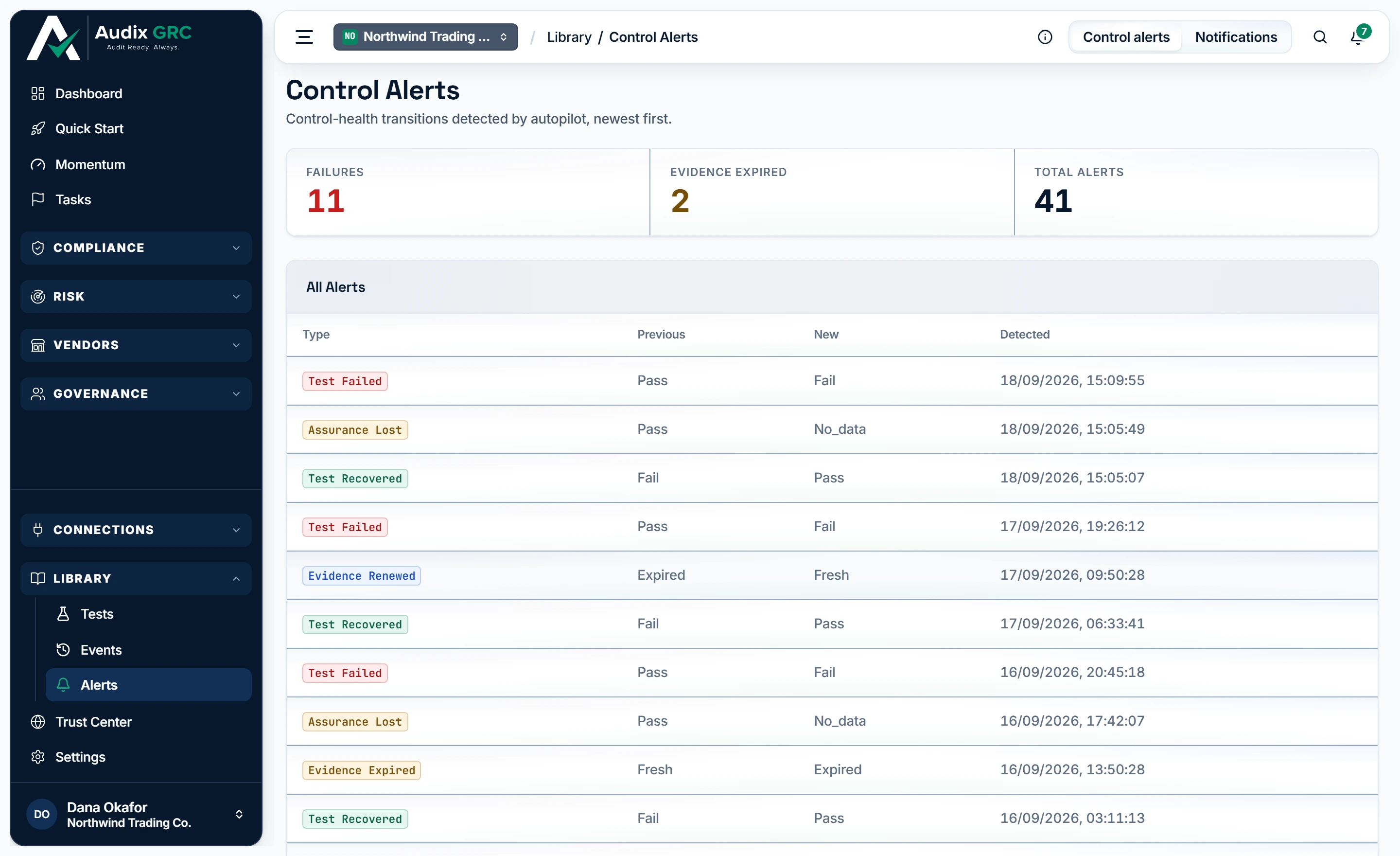
- How much is actually broken. Failures counts the checks that stopped passing, Evidence expired counts the artifacts that went stale; the two are separated because different people fix them.
- Both sides of every change. A row records what the control health was, what it became and when that was noticed, so a recovery is written down as plainly as a failure. Nothing on this page creates or dismisses an alert.
Every control-health transition, with tiles for Failures, Evidence expired and Total alerts, and a Type such as Test Failed, Failing since first checked or Passes with Accepted Failures. A switcher at the top moves between this and Notifications.
In Activity and settings
The task on this screen
Watch control health changeLive
The narrow log of control-health transitions: a check that started failing or fails from its first run, one that recovered, a control that became unverifiable, evidence that expired or was renewed.
As a member
- Open Alerts under Library, or click the Control alerts tab at the top right.
- Read the tiles "Failures", "Evidence expired" and "Total alerts".
- Read the All Alerts table: Type, Previous, New, Detected.
- Page through with the pager. The sizes are 5, 10, 20 and 25, and it opens on 20.
As an admin
- Same as a member.
Rules that apply
- Nothing on this page creates or dismisses an alert. It is a record of transitions that already happened.
- The five kinds are Test Failed, Test Recovered, Assurance Lost, Evidence Expired and Evidence Renewed.
- A failure can read Failing since first checked: the check has failed from its very first run, so nobody was told before. Failing means it was already failing before its first alert, so "started failing" would be untrue.
- A pass that is not a recovery says so. Passes with Accepted Failures means it passes only because failures were accepted, and Passes after a Scope Change means failing resources left what the check looks at. Nothing was fixed in either case.
- Assurance Lost means a passing check stopped returning a usable answer. That is different from failing.
- A row is raised when a check goes from pass to fail, from fail to pass, or from pass to an unusable result, and once for a check that fails without ever having raised a failure alert. A check that flaps between failing and unverifiable stays quiet after that.
- The Failures tile counts failures and assurance lost.
- The empty state reads "No alerts at this time".
2 questions
Questions about this screen
What does "Failing since first checked" mean on Control alerts?
The check has failed from its very first run, so nobody had been told about it before. Failing means the check was already failing before its first alert.
Why does an alert say "Passes with Accepted Failures" instead of Test Recovered?
The check passes only because its failures were accepted, so nothing was fixed. Passes after a Scope Change is similar: failing resources left what the check looks at.